This guide explains how football betting works, but also what most beginner guides leave out: what common betting approaches actually return over thousands of matches. The mechanics are simple. The honest picture of what they produce is less often discussed.
The markets, odds formats and how to place a bet take about ten minutes to learn. What separates a random bet from one grounded in analysis is harder, and that is what our database of 182,112 matches is here to address.
How Football Odds Work
Every price a bookmaker offers is an implied probability in disguise. The conversion is simple:
Implied probability = 1 ÷ decimal odds
A team at 2.00 implies a 50% chance of winning. A team at 1.50 implies 66.7%. A team at 4.00 implies 25%. Understanding this matters because it reframes the entire question of betting. You are not just picking who will win, you are deciding whether the bookmaker's probability estimate is accurate.
The bookmaker ensures a built-in margin by pricing all outcomes so the implied probabilities sum to more than 100%. In a standard 1X2 football market, the three implied probabilities typically add to 106–110%. That excess is the bookmaker's guaranteed edge, regardless of the result.
A simple example: A match is priced at Home 2.10, Draw 3.40, Away 3.60. The implied probabilities are 47.6%, 29.4%, and 27.8% - totalling 104.8%. The 4.8% excess is the overround. It represents the margin built into the market before the game is played.
This does not mean you cannot profit from betting. It means every bet starts from a position where the odds are stacked against you, and consistent profit requires finding situations where your probability estimate is more accurate than the bookmaker's by more than their margin.
The Main Football Betting Markets
Match Result (1X2)
The most common football bet. You back one of three outcomes: home win (1), draw (X), or away win (2). Stakes and returns are fixed at the time of the bet. The result after 90 minutes plus stoppage time determines the outcome, extra time and penalties do not count in standard 1X2 markets.
Over/Under Goals
You bet on whether the total number of goals in a match will be over or under a specific line, most commonly 2.5. Over 2.5 wins if three or more goals are scored. Under 2.5 wins with two or fewer. Half-goal lines (2.5, 3.5) eliminate the possibility of a push.
Both Teams to Score (BTTS)
A Yes/No market on whether both teams score at least one goal. Takes the match result out of the equation entirely, you can back BTTS Yes on a match you expect to be high-scoring regardless of who wins.
Asian Handicap
A handicap is applied to level the match. A −1 handicap on the home team means they start with a one-goal deficit for betting purposes, they must win by two or more for the bet to win. Quarter-goal lines (e.g., −0.75) split the stake across two adjacent lines, eliminating some void outcomes. Asian handicap removes the draw as a result, leaving only two outcomes.
Accumulators
Multiple selections combined into one bet, with odds multiplied together. Three selections at 2.00 each produce accumulator odds of 8.00. Every selection must win - one loss voids the entire bet. The appeal is large potential returns from a small stake. The mathematical reality is covered below.
In-Play Betting
Markets remain open after kick-off with odds updating continuously. Allows you to assess the match before committing, but live prices move fast and are often less favourable than pre-match prices on the same outcome.
The Basic Process of Placing a Bet
- Choose a licensed bookmaker. In the UK, look for Gambling Commission licensing. This governs fair play and protects your funds.
- Create and verify your account. Identity verification (proof of ID, address) is required by UK regulation before withdrawals.
- Deposit funds. Set a budget before depositing, not after.
- Browse fixtures and select a market. Most bookmakers organise by competition. Select your match, then choose the market and outcome.
- Check the odds and enter your stake. The potential return is displayed before you confirm.
- Keep records. Without records you cannot assess whether your approach is working or whether apparent profits are variance.
What the Data Shows About 1X2 Returns
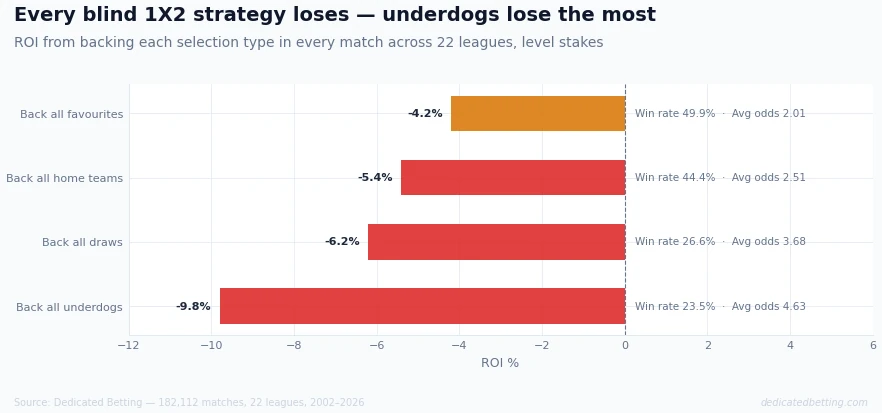
Most beginner guides explain how each market works without mentioning what they return. Here is what backing every match in four common 1X2 approaches produces across our database of 182,112 matches.
| Strategy | Matches | Win rate | Avg odds | ROI |
|---|---|---|---|---|
| Back all favourites | 182,112 | 49.9% | 2.01 | −4.2% |
| Back all home teams | 182,112 | 44.4% | 2.51 | −5.4% |
| Back all draws | 182,112 | 26.6% | 3.68 | −6.2% |
| Back all underdogs | 182,112 | 23.5% | 4.63 | −9.8% |
Every blind 1X2 approach loses. This is not a feature of bad luck or small sample sizes, it is the result of 22 years of data across 22 leagues. The loss comes from the bookmaker's margin applied consistently across hundreds of thousands of bets.
The differences between the strategies matter. Backing all underdogs at −9.8% ROI loses more than twice as fast as backing all favourites at −4.2%. A £1,000 bankroll staked at £10 per bet would lose approximately £420 over 1,000 bets backing favourites, versus approximately £980 backing underdogs. The approach that sounds most exciting, big odds, big potential returns, is historically the most expensive.
Backing the home team in every match loses −5.4%, slightly worse than backing the favourite. The two overlap heavily (favourites are often the home team) but the home team strategy is less selective, it backs home underdogs as well as home favourites, which drags the ROI down.
Draws at −6.2% are one of the most common "systems" recommended in betting content - back the draw every week, it pays 3/1 or better. The data is clear: it loses more than favourites and more than home teams, despite the appealing odds.
This does not mean football betting is always unprofitable. It means that selecting bets without analysis produces a consistent loss. The market prices outcomes accurately enough on average that blind selection loses. Profitable betting requires identifying specific situations where the price is wrong, covered in the value betting guide.
Why Accumulators Are Mathematically Harder
Accumulators compound the expected value of each individual leg. If each leg has a −4% ROI, a four-leg accumulator does not have −4% expected ROI, it has roughly −15%, because you are multiplying four negative-expectation bets together.
The occasional large payout from an accumulator win is real. The long-run expected return is worse than singles at the same odds. The variance is much higher, longer winning streaks and longer losing streaks, which makes performance harder to evaluate and bankroll management harder to practise.
Accumulators are not inherently bad. They are a reasonable choice if you want entertainment value from a small stake with a chance of a large payout. They are a poor choice if your goal is to find and exploit genuine betting edge, because the compounding of margin makes any edge harder to maintain and any losing selections more costly.
The Difference Between Betting and Analysis
Most bets are placed on the basis of preference, recent news, or a feeling about a team. This is betting. It is entertainment, and should be treated as such, with a budget set aside for the purpose and no expectation of profit.
Analysis is different. It requires a probability estimate, an actual number, not a feeling, and a comparison of that estimate to the implied probability in the odds. If your estimate is higher than the implied probability, and the difference exceeds the bookmaker's margin, you have a potential value bet. Without this process, you are not identifying edge, you are selecting bets at random.
The practical barrier is that the market is genuinely efficient. Most information about a football match is already reflected in the odds by the time you can access them. Your analysis needs to be more accurate than the market's, not just accurate in absolute terms.
The era trend in our data illustrates this: backing all pre-match favourites returned −6.4% ROI in the 2000–2010 era and −0.8% in 2021–2026. The same pattern appears across all four 1X2 approaches, each has moved toward breakeven as the market has priced these category-level patterns more accurately over time. The gap available to exploit has been narrowing.
Responsible Gambling
Football betting should have a defined budget, set before you start, that represents money you are prepared to lose entirely. Chasing losses, increasing stakes to recover previous losses, is the fastest route to significant financial harm. All major bookmakers offer deposit limits, cool-off periods and self-exclusion tools.
Our Responsible Gambling section covers staking principles, loss limits, and realistic expectations for anyone approaching football betting analytically. The bankroll management principles in our Bankroll Management guide are as relevant to data-driven betting as to any other approach - perhaps more so, because analytical methods can create false confidence in the reliability of an edge.
Using Dedicated Betting Data Before You Bet
Before betting on a match, the useful question is not "who do I fancy?" but "what evidence supports my probability estimate?" The tools on this site are built around that question.
League pages show whether a competition currently favours home teams, away teams, goals or draws, relevant context before assessing any 1X2 market. Team pages show whether a side performs differently at home and away, including PPG, win rates and goals split by venue.
H2H pages provide recent meeting context: recent scorelines, venue patterns, and whether fixtures between two sides have tended to be tight or open. Rankings highlight teams with strong home or away form across multiple time windows, helping distinguish structural strength from short-term variance.
These tools do not tell you what to bet. They help you test whether the odds are giving you a price worth considering.
Summary
Football betting is easy to start and the markets are straightforward. The harder truth is that blind selection in any major 1X2 category, favourites, home teams, draws, underdogs, has produced consistent losses across 182,112 matches of data. Underdogs lose nearly −10% per pound staked. Favourites lose the least at −4.2%, but still lose.
Profitable betting over the long run requires a probability estimate more accurate than the market's, and an edge that exceeds the bookmaker's margin. That is the actual challenge. The mechanics of placing a bet take minutes to learn. Developing accurate probability estimates takes considerably longer.
Starting point: Before placing any bet, convert the odds to implied probability (1 ÷ decimal odds), form your own estimate of the true probability, and only bet when your estimate is meaningfully higher and you have a specific reason for the difference. If you cannot articulate the reason, you do not have an edge, you have a preference.
Selection system ROI figures from the Dedicated Betting database: 182,112 matches with valid odds data across 22 divisions, 2002–03 to 2025–26. Level stakes, best available odds (Max → Average → B365 cascade). Full methodology in the Football Betting Strategy pillar article.
Related articles
What is value betting in football?
The mechanics of identifying mispriced odds - implied probability, the bookmaker's margin, and where the football market has historically been least accurate: What Is Value Betting in Football.
Do football betting systems work?
Selection systems and staking systems tested against real match data - including why Martingale fails and what Kelly Criterion actually requires: Football Betting Systems.
Is betting on favourites profitable?
The home/away favourite split, era trend, and league-by-league breakdown across 182,247 matches: Is Betting on Favourites Profitable.