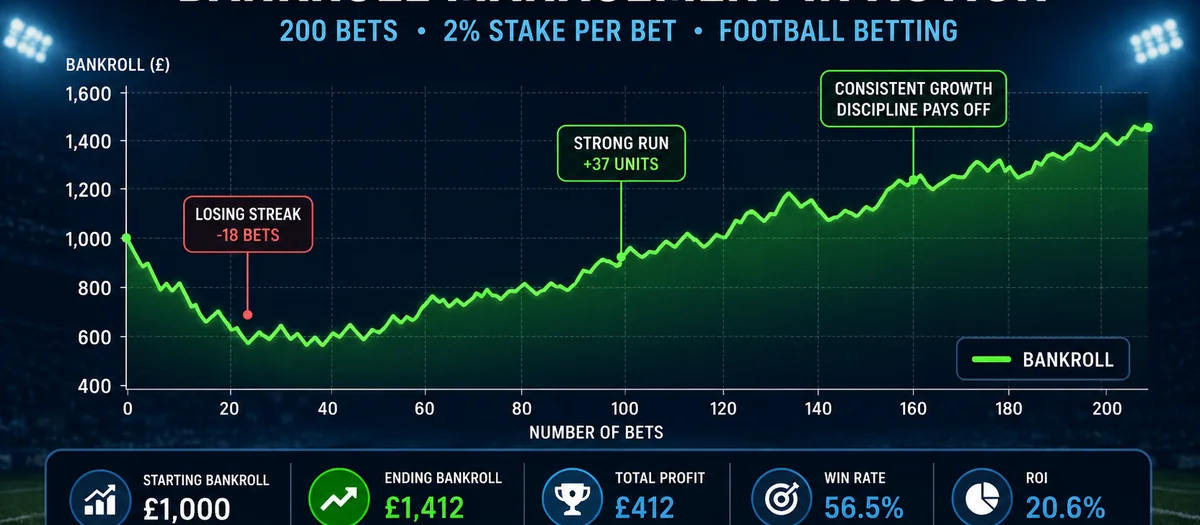
Most bettors don't lose because they can't pick winners - they lose because they don't manage their money.
Bankroll management is the discipline that separates those who survive long enough to profit from those who blow their stake on the first rough patch. Without it, even a genuinely profitable strategy will fail. With it, you give yourself a realistic chance of staying in the game while the numbers work in your favour.
This guide explains how betting bankroll management works, which staking strategies make sense for football, and how to build a simple framework you can apply immediately.
Key takeaway: Bankroll management is not about picking more winners. It is about controlling stake size so normal losing runs do not wipe you out.
What Is Bankroll Management?
Your bankroll is the amount of money you have set aside exclusively for betting. Not your savings. Not this month's spare cash. A defined, ring-fenced pool you are prepared to deploy, and prepared to lose.
Bankroll management is the process of deciding how much of that pool to risk on any single bet. Get this wrong in either direction - stakes too large and a bad run destroys you; stakes too small and returns are negligible - and no amount of analytical skill rescues you.
The question bankroll management answers is straightforward: how much should I stake on each bet to survive variance and allow my edge to play out over time?
Why Variance Makes This Non-Negotiable
Football betting is heavily shaped by variance. That means the better team does not always win, the obvious pick does not always land, and a good decision can still lose on the day.
Across many major European leagues, draws alone account for roughly one match in four. Underdogs also win often enough to matter, commonly around one match in five or more depending on the league and season. Put simply, a large share of football matches do not end with the favourite winning.
That is before you even factor in red cards, injuries, missed chances, penalties, deflections and late goals. Football is low scoring, so one incident can change the result. That is variance in plain English.
This is why bankroll management matters. A good betting approach is not about being right every time. It is about understanding that losing runs are normal, protecting your bankroll, and judging bets over hundreds of decisions - not one match.
Losing streaks are inevitable - even with a positive edge
Consider a bettor with a genuine 40% win rate on selections at average odds of 2.50. This is a profitable strategy over the long run. Yet with a 60% loss rate per bet, the statistically expected longest losing streak across 100 bets is approximately 9 to 10 consecutive losses.
That is not bad luck. It is normal, expected, variance.
Now consider what happens to your bankroll at different stake sizes during that inevitable run:
| Stake per bet | Loss after 10 consecutive losses |
|---|---|
| 10% of bankroll | −65% |
| 5% of bankroll | −40% |
| 2% of bankroll | −18% |
| 1% of bankroll | −10% |
At 10% stakes, a normal variance event leaves you needing a 186% return just to recover. At 2%, the same run is survivable and recoverable. This is why stake sizing is not a minor detail - it determines whether your strategy gets the chance to prove itself.
Important: A 10-bet losing run is not extreme in football betting. If your stake size cannot survive that, your staking plan is too aggressive.
Core Staking Strategies
1. Fixed Staking
You bet the same monetary amount on every selection regardless of bankroll size.
Example: £1,000 bankroll, £20 per bet - always.
This is the simplest approach and removes the temptation to scale up after wins or down after losses. The downside is that it does not adapt. If your bankroll grows to £2,000, your exposure effectively halves. If it drops to £500, your exposure doubles. Neither is ideal.
Best for: Beginners who want a simple, disciplined staking method.
Avoid if: You want your stake size to automatically adjust as your bankroll rises or falls.
2. Percentage Staking
You stake a fixed percentage of your current bankroll on each bet.
Example: £1,000 bankroll, 2% stake → £20. After a run drops the bankroll to £800, the stake automatically becomes £16.
This is the most practical approach for the majority of bettors. It protects against drawdowns by reducing stakes during losing runs, and scales up gradually during winning periods. The psychological discipline required is higher - small stakes during a downturn feel frustratingly cautious - but that caution is precisely the point.
Recommended range: 1–3% per bet. At the upper end for higher-confidence selections in leagues you have studied; at the lower end for any bet where uncertainty is higher.
Best for: Most recreational bettors and anyone who wants sensible risk control.
Avoid if: You struggle to reduce stakes during losing runs.
3. Kelly Criterion
Kelly Criterion is a formula-based staking method. It tries to calculate how much of your bankroll you should stake based on your perceived edge.
In simple terms, Kelly asks:
“If these odds are available, and I think the true chance of this bet winning is higher than the market suggests, how much should I stake?”
The formula is:
f* = (bp − q) / b
Where:
- f* = fraction of bankroll to stake
- b = net decimal odds, meaning decimal odds minus 1
- p = your estimated probability of the bet winning
- q = 1 - p, meaning the probability of losing
Worked example:
- Decimal odds available: 2.50
- Your estimated win probability: 45%
- b = 1.50
- p = 0.45
- q = 0.55
So:
f* = (1.50 × 0.45 − 0.55) / 1.50
f* = 0.125 / 1.50 = 8.3% of bankroll
That means Full Kelly would suggest staking 8.3% of your entire bankroll on one bet.
That is the problem.
Kelly can be mathematically powerful in theory, but it is extremely unforgiving in practice. If your estimated edge is wrong, even slightly, the formula can push you into stakes that are far too aggressive.
For example, if you think a team has a 45% chance of winning, but the true chance is only 40%, your whole stake calculation is built on a bad assumption. The formula has not protected you, it has amplified your mistake.
That is why many serious bettors who use Kelly do not use Full Kelly. They often use:
- Half Kelly - half the suggested stake
- Quarter Kelly - one quarter of the suggested stake
In the example above:
- Full Kelly = 8.3%
- Half Kelly = 4.15%
- Quarter Kelly = 2.1%
For most recreational bettors, Kelly is probably more complexity than they need. Unless you can estimate probabilities better than the market, Kelly can give a false sense of precision.
A simpler percentage staking plan with a sensible maximum stake is usually easier to understand, easier to follow, and much safer for normal bettors.
Simple rule: if you do not fully understand Kelly, or you cannot explain where your probability estimate came from, you are probably better off not using it.
Best for: Advanced bettors with reliable probability estimates.
Avoid if: You cannot clearly explain where your estimated edge comes from.
A Practical Bankroll Framework
Use this as a simple starting point:
- [ ] Define a separate betting bankroll
- [ ] Set your standard unit size
- [ ] Cap daily exposure
- [ ] Avoid chasing losses
- [ ] Track every bet by league, odds, stake and result
- [ ] Review performance only after a meaningful sample
Here is the framework in more detail.
Step 1 - Define and ring-fence your bankroll Set a specific amount. Open a separate account or use a clearly labelled pot. Never top it up from personal funds after losing runs, this defeats the entire discipline.
Step 2 - Set your unit size For most bettors: 2% per bet. If you are selective and confident in your analysis, 3% is defensible. If you are betting across multiple leagues or experimenting with a new approach, stay at 1%.
Step 3 - Cap daily exposure Never have more than 10–15% of your bankroll active across all open bets at once. Stacking five 3% bets that correlate, for example all on Tuesday night football, concentrates risk rather than spreading it.
Step 4 - Commit to flat stakes Do not increase stakes after wins because you are feeling good. Do not chase losses with larger bets. Recalculate your unit size only when your bankroll has moved meaningfully (say, ±20% from when you last set it).
Step 5 - Track and review by league This is where most recreational bettors fall short. A simple spreadsheet recording stake, odds, result, and league for each bet reveals where your edge actually exists - and where it does not. ROI across 50+ bets by competition tells you more than any single winning run.
How League Characteristics Should Influence Your Approach
Not all leagues carry the same variance profile, and this matters when calibrating your stake sizing.
Leagues with high draw rates (Serie A, Ligue 1) produce more unpredictable outcomes on a match-by-match basis. Home advantage is significantly stronger in some leagues than others, it is measurably weaker in the Bundesliga than in the Turkish Süper Lig, for example. Leagues with high upset rates, where lower-ranked sides regularly beat favourites, require more conservative staking because the expected deviation from form is larger.
The power ratings and form data available on this site give you a factual basis for understanding how predictable or volatile a given league is before you commit a stake. A match in a high-variance league warrants a more conservative position than the same confidence level applied to a more predictable competition.
Common Mistakes
Chasing losses - Increasing stakes to recover quickly is the most reliable way to destroy a bankroll. The mathematics that caused the loss still apply; you are now just losing larger amounts.
Overstaking - Betting 5–10% per selection is far too aggressive for football betting. The variance analysis above shows why. Even a profitable strategy fails under poor risk control.
Treating variance as failure - A losing week does not mean your approach is wrong. A losing month might not either. Judging a strategy on fewer than 100 bets produces meaningless conclusions.
Betting volume for its own sake - More bets does not mean more profit. It usually means more exposure to randomness. The discipline of passing on a game you have no clear read on is as important as the discipline of betting one you do.
The Long Game
Bankroll management is not about maximising short-term profit. It is about staying solvent long enough for your edge - assuming you have one - to produce returns.
Football betting is inherently noisy. Variance is unavoidable. The bettors who survive are not always those with the best analytical models. They are those who did not blow their bankroll during the runs of bad luck that come for everyone.
Data and analysis improve your decisions. Bankroll management determines whether you are still betting when those decisions start paying off.
Final thought: Good analysis helps you find better bets. Good bankroll management keeps you alive long enough for that analysis to matter.