In 2020 and 2021, professional football ran the largest unintentional experiment in its history. Governments across Europe closed stadiums to supporters. For the first time, we could measure what happened to home advantage when you removed the crowd entirely.
The answer, across 22 leagues and thousands of matches, is more complicated than most coverage suggests. Crowds clearly affect how football is played. But academic research published after the Covid seasons found that the reduction in actual home advantage measured by goals and points was not statistically significant in the top European leagues, even as referee decisions and match dominance shifted dramatically. Other factors such as familiarity, travel, psychology, appear to be the dominant base driver of home advantage, with crowds amplifying rather than causing it.
Our 22-league database adds a dimension that the academic literature did not cover: the variation across competitions, including lower divisions. That variation tells a more complete story.
Key takeaway: Crowds clearly influence referee decisions and match dynamics. But academic evidence and our own 22-league data both suggest they are not the primary driver of home advantage. Their impact varies enormously by league - and in some competitions, removing fans made almost no difference at all.
What Happened When the Fans Left
Across all 22 leagues combined, the average home goal advantage dropped from +0.36 per match in normal seasons to +0.23 in 2020–21, a fall of roughly a third. Home teams still won more than away teams, but the gap narrowed sharply.
The league-by-league picture is where the real story lies.
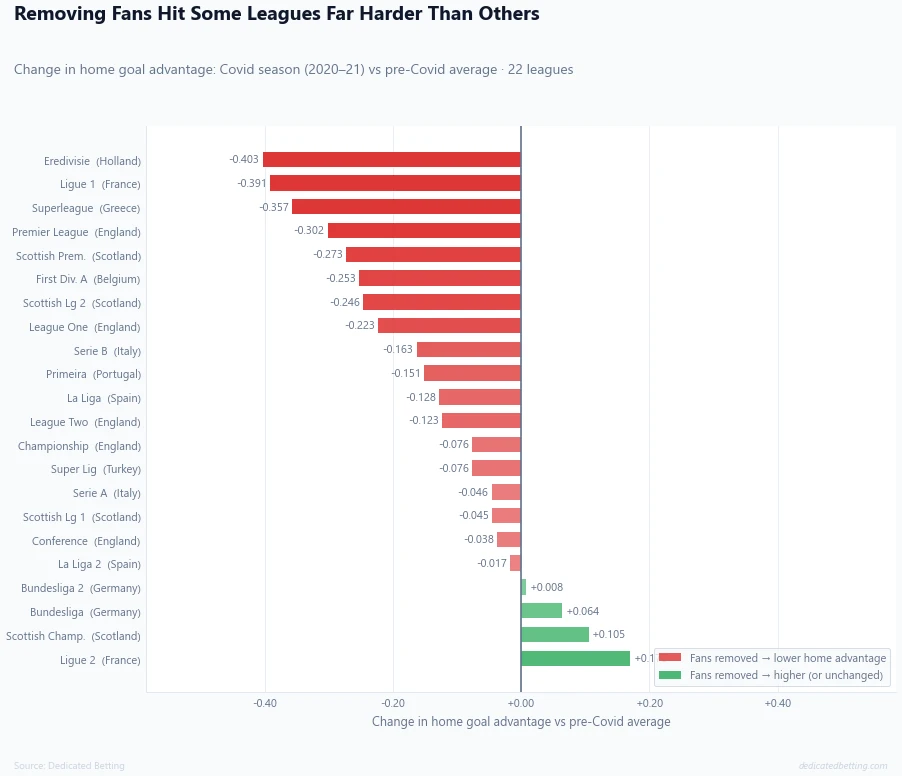
The range is extraordinary. The Eredivisie lost −0.40 goals of home advantage when fans were removed, two thirds of what had been the strongest home advantage reading in our entire 22-league database. Ligue 1 lost −0.39, dropping from +0.425 to almost exactly neutral (+0.034). The Greek Superleague fell −0.36. The Premier League lost −0.30, falling to just +0.01 - essentially coin-flip home vs away.
Then there are the leagues at the other end. The Bundesliga's home advantage did not fall, it increased by +0.06, rising from +0.26 to +0.32. Ligue 2 saw an increase of +0.17. Scottish Championship and Bundesliga 2 also showed small increases.
Sixteen of the 22 leagues saw home advantage fall without fans. Six saw it hold or improve.
The Anomaly: Why Did Some Leagues Get More Home Advantage Without Fans?
The leagues where removing fans appeared to increase home advantage are not random. They share some characteristics worth examining in more detail.
Ligue 2 and the Bundesliga 2 are second-tier competitions where the typical matchday atmosphere is relatively modest compared to the top flights. The Scottish Championship, similarly, plays in front of small, often quiet crowds. The Bundesliga, despite its global reputation, plays in large modern stadia where crowd noise is more dispersed than in the tightly-packed older grounds of the Dutch or Greek leagues.
The most likely explanation is that crowd effects in these competitions were already minimal, and other factors that favour home teams (familiarity with the pitch, absence of travel fatigue, tactical preparation in familiar surroundings) continued operating normally or were even amplified in the unusual conditions of "bio-secure" bubble environments and shortened travel windows.
It is also worth noting that the 2020–21 season was operationally unusual beyond just the absence of fans: fixture congestion, squad rotation, different preparation windows and the psychological stress of the pandemic affected all clubs but not equally. Some of these factors may have worked in home teams' favour in ways unrelated to crowd dynamics.
The honest conclusion: the anomaly leagues do not disprove the crowd effect, the 16 leagues that declined are clear evidence it exists. But they do challenge the idea that crowd noise is the only or primary mechanism behind home advantage. In competitions where the crowd effect was already weak, other factors appear to have been the dominant driver all along.
The Amateur Football Evidence
One of the most striking findings in the Wunderlich et al. research came not from professional football at all, but from German amateur leagues.
The study included data from the Kreisliga A - a very low division of German football, essentially representing leisure-level competition. In this environment, meaningful crowds are almost entirely absent even in normal circumstances. Over 5,624 matches, the home advantage in these amateur leagues was statistically comparable to professional matches played without spectators during Covid.
The implication is significant: even when crowds have never been present to begin with, home teams still win more often than away teams. Familiarity with the pitch, the absence of travel for the home side, and the psychological comfort of playing in a known environment appear sufficient to generate a measurable home advantage without any crowd involvement at all.
This does not mean crowds are irrelevant, the professional Covid data clearly shows they affect referee decisions and match dynamics. But it does suggest they are amplifiers of an underlying advantage rather than the source of it. The base home advantage exists independently of the crowd. The crowd adds to it in certain competitions more than others.
Why Crowds Matter Where They Do
For the leagues where the impact was severe - the Eredivisie, Ligue 1, Superleague, Premier League - the evidence points to two overlapping mechanisms.
- Referee influence. The clearest finding from the Covid seasons is that crowd removal eliminated referee bias almost entirely. A 2021 study by Wunderlich, Weigelt, Rein and Memmert published in PLOS ONE analysed over 37,000 professional matches and found that the gap between home and away teams in fouls received, yellow cards and red cards, all statistically significant in normal conditions, completely disappeared in matches without spectators (p < .001 for fouls and yellow cards). Home teams were no longer being sanctioned less than away teams once the crowd was gone. The authors concluded that crowd presence is likely the primary or sole reason for referee bias in professional football.
The same study found that shots and shots on target - measures of match dominance - fell by roughly 50% without fans. Home teams still created more chances, but the gap narrowed sharply. What is striking is that despite these clear changes in process, the reduction in actual goals and points home advantage was not statistically significant (p = .449 for goals). The crowd appears to influence how matches are played more than it determines who wins.
We did not study referee decision in our initial analysis, but the aggregate goal advantage figures across 22 leagues reflect the combined outcome of all these process changes. The leagues where we found the biggest drops are those where the process effects - referee bias, crowd intimidation, home team confidence - were most amplified to begin with.
-
Player and team psychology. Home crowds create intensity that affects both sets of players differently. Home players draw confidence from familiar support; away players face an additional psychological burden on top of playing in an unfamiliar environment. Research into player performance metrics found that some performance indicators - sprint intensity, pressing triggers, set piece aggression - shifted toward the away team when crowds were absent. Whether this is crowd-driven or a product of the broader 2020–21 disruption is harder to separate from the data.
-
The intimidation of specific grounds. Not all crowds are equal. Playing at Feyenoord's De Kuip, Olympiakos's Georgios Karaiskakis, or a sold-out Celtic Park is qualitatively different from a half-filled stadium with modest support. The leagues that showed the biggest drops are precisely those where the most intense, most proximate crowd environments exist. The correlation is not coincidental.
Did Home Advantage Recover When Fans Returned?
Fans began returning to grounds in the 2021–22 season. The question the data can answer is whether home advantage bounced back - and for most leagues, the honest answer is: only partially, and unevenly.
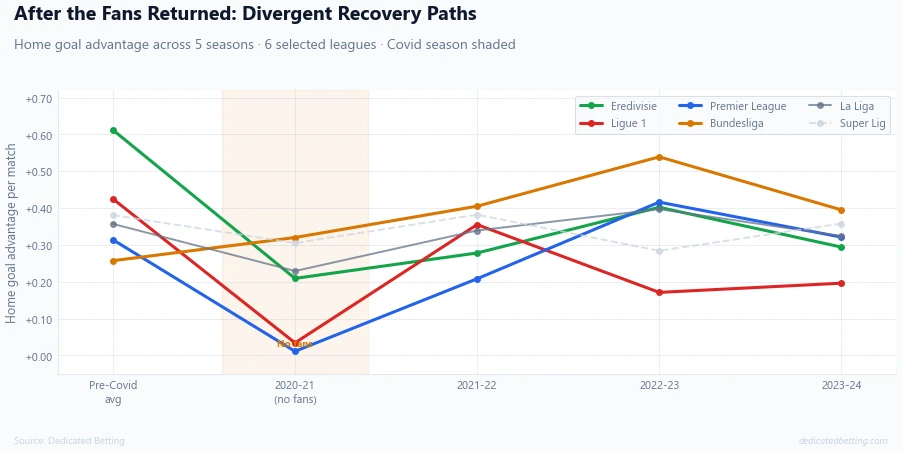
The Eredivisie is the starkest case. Its pre-Covid home advantage of +0.61 was the highest in our database. By 2023–24, three seasons after fans returned, it had recovered to only +0.29 - less than half the pre-Covid level. Whatever drove the extraordinary Dutch home advantage of the late 2010s has not returned. Whether this is a permanent structural change or a delayed recovery remains to be seen, but three seasons of data suggests something more than a temporary disruption.
Ligue 1 follows a similar pattern. Pre-Covid +0.43, now sitting at +0.20 in recent seasons. The recovery has been partial and inconsistent.
The Premier League's recovery has been volatile rather than steady. After the Covid low of +0.01, it rose to +0.42 in 2022–23 before falling back to +0.32 in 2023–24 and to +0.09 in 2024–25 - the second worst non-Covid season in 33 years of data.
The Bundesliga tells the opposite story. Its home advantage was already increasing during the Covid season and has continued rising, reaching +0.54 in 2022–23. La Liga has broadly recovered to near pre-Covid levels. The Super Lig barely registered the disruption in either direction and has remained stable throughout.
The non-recovery in the Eredivisie and Ligue 1 is particularly interesting because these were historically the most crowd-dependent leagues in the database. If crowds were the primary driver, their return should have restored home advantage. It has not - which suggests the baseline home advantage in those leagues may have been elevated by a combination of factors in the 2015–2020 period that were not solely crowd-driven, and the Covid disruption accelerated a pre-existing structural decline.
What This Means for Betting Analysis
The crowd effect data has two practical implications.
-
Matches played behind closed doors or in significantly reduced capacity grounds should be treated as a different analytical environment. The Covid data quantifies what that means by league: a Premier League match without fans is worth approximately −0.30 in expected home goal advantage - close to neutral. A Bundesliga match without fans showed essentially no change. Applying the same adjustment across all competitions would be incorrect.
-
League-level crowd intensity is relevant context when assessing home advantage. The leagues at the top of the crowd-impact chart - Eredivisie, Ligue 1, Superleague - are competitions where the home environment historically contributed more to results than the bare statistics suggest. Our league pages show current season home advantage data that already reflects these dynamics in live match results.
-
Recent seasons matter more than historical averages for crowd-dependent leagues. The Eredivisie and Ligue 1 have not recovered to their pre-Covid baselines. Using their 30-year historical home advantage figures as a reference point overstates what the data currently shows. The current era data in our league comparison article gives a more accurate picture.
Summary
The Covid natural experiment produced a more nuanced picture than most coverage suggests. Referee bias clearly disappeared without fans - the academic evidence on that point is unambiguous. Match dominance shifted. But the reduction in actual goals and points home advantage was not statistically significant in top European leagues, according to peer-reviewed analysis of over 37,000 matches.
Our 22-league data adds the variation dimension. In some competitions - the Eredivisie, Ligue 1, Greek Superleague - the impact was dramatic. In others - the Bundesliga, Ligue 2, Super Lig - home advantage was unaffected or increased. That variation is not noise. It reflects genuine differences in how crowd-dependent each competition's home advantage actually is.
The amateur football evidence reinforces the conclusion: home advantage exists even where meaningful crowds have never been present. Crowds amplify an underlying advantage driven by familiarity, travel asymmetry and psychology - they do not create it from scratch.
Recovery after 2021 has been uneven. Several leagues have not returned to pre-Covid baselines three seasons on, suggesting the disruption may have accelerated structural changes that were already under way.
The honest answer to the title question is: yes, crowds matter - but they are not the primary cause of home advantage, and their contribution varies so much by competition that treating them as a uniform factor is a significant analytical error.
Final thought: Crowds influence referee decisions and match dynamics clearly. But home advantage exists without them. Their impact is league-specific - strongest in the Eredivisie and Ligue 1, almost absent in the Bundesliga. The underlying advantage from familiarity, travel and psychology operates regardless of attendance.
All statistics drawn from the Dedicated Betting database, covering up to 239,669 matches across 22 football divisions. Pre-Covid baseline uses 2018–19 and 2019–20 seasons. Covid season is 2020–21. Recovery seasons cover 2021–22 to 2023–24.
Academic reference: Wunderlich F, Weigelt M, Rein R, Memmert D (2021). "How does spectator presence affect football? Home advantage remains in European top-class football matches played without spectators during the COVID-19 pandemic." PLOS ONE 16(3): e0248590. https://doi.org/10.1371/journal.pone.0248590
Related football articles
Which leagues have the biggest home advantage?
The crowd effect is one reason why home advantage varies so much between competitions. Our League Comparison article ranks all 22 leagues and shows how the rankings have shifted over 30 years.
Is home advantage declining in the Premier League?
The Premier League's home advantage story since 1993 - including the full Covid season analysis and the goals data behind the decline - is in our Premier League home advantage article.
Does home advantage still matter in football?
For the full 33-season picture across all 22 leagues, read our Home Advantage in Football pillar article.